What sound does a shoebill make? What bill clattering is and means

The best-known shoebill sound is the clack-clack-clack of the bill snapping together. Otherwise, it is a bird that makes almost no calls at all.
At a glance
This article walks through 11 topics, in this order.
- What does a shoebill sound like?
- How does a shoebill make the clattering sound?
- What other sounds and calls do shoebills make?
- Why do shoebills sound like gunshots or machine guns?
- What does bill clattering mean?
- Why don't shoebills usually call?
…and 5 more in the contents below.
Contents
- What does a shoebill sound like?
- How does a shoebill make the clattering sound?
- What other sounds and calls do shoebills make?
- Why do shoebills sound like gunshots or machine guns?
- What does bill clattering mean?
- Why don't shoebills usually call?
- What about the shoebill's "moo" and the chicks' calls?
- Do shoebills and storks sound alike?
- How do zoos around the world describe the shoebill's sound?
- Can you hear a shoebill at a zoo?
- Sources
What does a shoebill sound like?
The most famous shoebill sound is bill clattering (rapidly snapping the bill together). It is not a call made with the throat. It is a sound made with the bill.
Most birds sing or call with the syrinx (a bird's voice organ, deep in the throat). Shoebills hardly use that voice.
The Animal Diversity Web of the University of Michigan describes the shoebill as a generally quiet bird. Instead, it often shows the behavior of clattering its bill.
Written out, it sounds like "clack-clack-clack..." or "kakakaka...". Mandai Bird Paradise in Singapore describes the sound as a loud, hollow-sounding rattle.
For other names for the shoebill's sounds, the description from ZooTampa in the United States is easy to follow. The adult's cow-like call is written as mooing, and the chick's call is written as hiccupping.
How does a shoebill make the clattering sound?
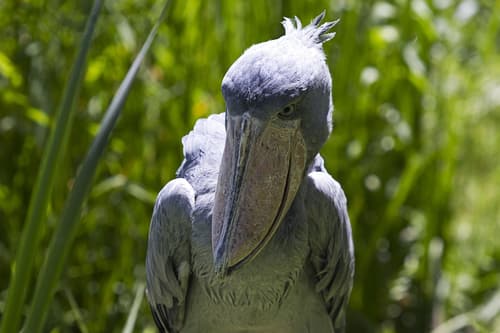
It strikes the upper and lower halves of its bill together quickly, again and again. The bill is big and hard, 18.8 to 24 cm long, so the sound carries well.
_-_Weltvogelpark_Walsrode_2010.jpg/1280px-Schuhschnabel_(Balaeniceps_rex)_gaehnend)_-_Weltvogelpark_Walsrode_2010.jpg)
Kobe Animal Kingdom (神戸どうぶつ王国) also describes this behavior, striking the bill together to make a sound, as clattering.
A shoebill's bill is a sturdy shape, both wide and deep. The striking surfaces are large, so the force of the sound is nothing like the bill sound of a small bird. The structure of the bill is covered in Shoebill bill.
Clattering is often seen together with a bow, in which the bird lowers its neck. The meaning of the bow is summed up in Shoebill bowing.
In the sources we checked, we could not find any study that measured how loud the sound is (in decibels) or how many times the bill strikes in one burst.
What other sounds and calls do shoebills make?
Besides clattering, a few calls made from the throat are known. All of them are rarely heard.
| Sound or call | What it is like | Made by | Source |
|---|---|---|---|
| Clattering | A clacking sound made by snapping the bill | Adults, juveniles and chicks | Animal Diversity Web |
| Cow-like call | A low call like a "moo" | Adults | Hancock et al. (1992), Animal Diversity Web |
| High call | A thin, high, whimpering call | Adults | Hancock et al. (1992), Animal Diversity Web |
| Hoarse call | A raspy, croaky call | Adults | Hancock et al. (1992) |
| Hiccup-like call | Sounds a lot like a human hiccup | Chicks (when begging for food) | Hancock et al. (1992), Animal Diversity Web |
Here is the key point. The star of the shoebill's "voice" is not a voice but the sound of the bill. Hearing a call from the throat is a real stroke of luck.
Why do shoebills sound like gunshots or machine guns?
It is because the fast, loud, repeated striking in clattering sounds like rapid gunfire.
The hard bill halves hit each other many times at short intervals. That "ta-ta-ta-ta" rhythm is compared to the sound of a machine gun. When people on the internet say it sounds like a shootout or is scary, this is the sound they mean.
But clattering is not a signal of attack. Most of the time it is a greeting. Compared with how intense it looks and sounds, the behavior itself is very gentle.
 Kou
It may sound scary, but most of the time it just means "hello". We're not birds that call out loudly all day.
What does bill clattering mean?
Most clattering is a greeting between a pair, or between a parent and its chick, when they meet at the nest. It is also seen during courtship.
According to the Animal Diversity Web, adult shoebills greet each other with clattering when they meet at the nest. Chicks and juveniles clatter their bills too.
ZooTampa in the United States also describes clattering as a greeting between a pair. In the explanatory sheet from Kochi Prefectural Noichi Zoological Park (高知県立のいち動物公園), clattering together with lowering the head is described as showing affection. In the breeding season, a male and female are said to bow to each other.
In zoos, birds are also known to clatter at keepers they like. Some birds, such as Futaba (ふたば) of Kakegawa Kachoen (掛川花鳥園), show it together with a bow.
Why don't shoebills usually call?
In the sources we checked, we could not find any study on why shoebills are usually silent. What is known is that they live a quiet life, mostly alone, waiting for fish.
Look at the AEWA conservation plan (the international agreement to protect waterbirds of Africa and Eurasia). Apart from the time they are raising young, shoebills are said to live mostly alone. The Animal Diversity Web says that the senses a shoebill relies on for hunting are mainly sight and hearing.
Their prey, the lungfish, comes up to the surface to breathe. According to FishBase, a database on fish, the kind of lungfish shoebills often eat is a fish that cannot survive without gulping air. The shoebill waits perfectly still for that one moment of breathing. Hunting is covered in How a shoebill hunts.
KouFrom here on, this is Kou's guess. Hunting depends on sight and hearing, so staying quiet might make it easier to notice the signs of fish. And since we always live alone, maybe we don't need many calls to summon far-off friends.
What about the shoebill's "moo" and the chicks' calls?
Adults sometimes make a low, cow-like call or a high call. Chicks make a call like a human hiccup when begging for food.
The source on calls is the bird reference book *Storks, Ibises and Spoonbills of the World* (Hancock et al., 1992). It lists three calls: a cow-like call, a hoarse call and a high call.
On the chick's call, the same book says it is eerily similar to a human hiccup. When a parent brings food, the chick begs with this call.
In a study in Zambia, a parent brought food to the nest 1.2 times a day on average (Mullers & Amar, 2015). The results came from cameras placed at nests, and food was brought most often early in the morning and late in the morning.
For roughly the first 40 days after hatching, the parents hardly left the nest. They left only to fetch water to cool the chick and material for the nest. You can read more about chicks in Baby shoebill.
KouFrom here on, this is Kou's guess. At the nest, adults greet each other with clattering, and parents bring food mostly in the morning. Maybe the sound of bills echoes around wild nests most in the morning hours, too.
Do shoebills and storks sound alike?
Clattering, the striking of the bill, is very similar to what storks do. But the shoebill is not a member of the stork family.
For the Oriental stork (konotori, コウノトリ) in Japan, a document from the Ministry of Land, Infrastructure, Transport and Tourism explains it as follows. They call as chicks, but stop calling a while after leaving the nest. Instead, they clatter their bills with the head bent back until it nearly touches the back.
The white stork of Europe also clatters its bill, in a display (a set pattern of movements shown to others) in which it moves its neck up and down.
There is a difference in posture. A stork clatters while bending its head back toward its back. A shoebill often clatters together with a bow, lowering its neck. The sound is the same, but the movements look almost opposite.
| Item | Shoebill | Oriental stork | White stork |
|---|---|---|---|
| Adult voice | Hardly makes any | Stops calling after leaving the nest | Sometimes makes soft calls |
| Clattering | Greeting and courtship at the nest | Threat and communication | In a display with the neck moving up and down |
| Chick voice | Hiccup-like call | Calls when begging for food | No description found |
| Classification | Order Pelecaniformes | Order Ciconiiformes | Order Ciconiiformes |
According to the Animal Diversity Web, the shoebill's syrinx is similar to a heron's. On the other hand, its clattering and the tiny bones of its ear (ear ossicles) are similar to a stork's. Its classification was hard to settle because these features are mixed together.
KouFrom here on, this is Kou's guess. Storks and shoebills both have big, hard bills. Maybe two kinds of birds that don't use their voices much each reached the idea of talking with the bill by their own separate paths.
How do zoos around the world describe the shoebill's sound?
Zoos around the world also describe the shoebill as a generally quiet bird that clatters its bill as a greeting. Their descriptions are very similar from zoo to zoo.
| Facility | Country | Description on official website |
|---|---|---|
| ZooTampa | United States | Mostly quiet. Clattering as a greeting between a pair. Adults "moo" and chicks make a hiccup-like call |
| Dallas World Aquarium | United States | Usually quiet. Clattering seems to be used as a greeting at the nest. Young birds practice it too |
| Mandai Bird Paradise | Singapore | Usually quiet. Makes a loud, hollow-sounding noise when greeting or building a nest |
| Kochi Prefectural Noichi Zoological Park (高知県立のいち動物公園) | Japan | Clattering and bowing show affection |
The Dallas World Aquarium uses the word "practice" for the clattering of young birds. The Animal Diversity Web also says that chicks and juveniles clatter their bills. The early years are covered in Juvenile shoebill.
Both of the facilities in the United States are places you can visit. They are introduced in Shoebills at ZooTampa and Dallas World Aquarium.
Can you hear a shoebill at a zoo?
Sometimes you can. The chances are best when a keeper comes close, or when two birds face each other.
As of October 2026, the zoos in Japan with two or more shoebills are as follows.
| Facility | Number of birds (as of October 2026) | Notes |
|---|---|---|
| Ueno Zoo (恩賜上野動物園), Tokyo | 4 | Plans to move Milly and Hatuwe to an off-exhibit facility for breeding (the October 26 date was postponed; no new date is set) |
| Kobe Animal Kingdom (神戸どうぶつ王国), Hyogo | 3 | A young pair, Sakara and Kuraru, arrived in 2025 |
| Kochi Prefectural Noichi Zoological Park (高知県立のいち動物公園), Kochi | 2 | Explanatory sheet covers clattering and bowing |
| Chiba Zoological Park (千葉市動物公園), Chiba | 2 | Off display until around spring 2028 |
At Ueno Zoo, after the two birds move, the birds left in the exhibit will be two females, Asante and Sana. The move was planned for October 26 but has been postponed, and all four are on display for now (as of October 23, 2026). Even with two females, watch how they act when they face each other.
According to the introduction from Noichi Zoological Park, the female Kashishi greets every staff member who comes into the room. The male Sasa is also written to show greeting behavior.
Even at a facility with a single bird, you may be able to hear the sound when it greets a keeper. You cannot always hear it, so check the official information before you go, and wait with the attitude that it is lucky if you do. The places where you can meet shoebills are summed up in Japan's zoos.
If you would like to hear the sound in a video, Shoebill videos may also help.
Sources
- Animal Diversity Web (University of Michigan): Balaeniceps rex
- Animal Diversity Web (University of Michigan): Ciconia ciconia (white stork)
- Descriptions from Hancock, Kushlan & Kahl (1992), Storks, Ibises and Spoonbills of the World (checked through citations on English Wikipedia)
- Mandai Bird Paradise (Singapore): Shoebill
- ZooTampa: Shoebill Stork
- Dallas World Aquarium: Shoebill Stork
- Kochi Prefectural Noichi Zoological Park (高知県立のいち動物公園): Explanatory sheet on the shoebill (in Japanese)
- Kochi Prefectural Noichi Zoological Park (高知県立のいち動物公園): Shoebill (in Japanese)
- Ministry of Land, Infrastructure, Transport and Tourism, Kanto Regional Development Bureau: What kind of bird is the Oriental stork? (in Japanese)
- Dodman (2013): International Single Species Action Plan for the Conservation of the Shoebill (AEWA Technical Series No.51)
- Mullers & Amar (2015): Parental nesting behavior and chick growth (Waterbirds)
- FishBase: Protopterus aethiopicus (marbled lungfish)
- Kobe Animal Kingdom (神戸どうぶつ王国): Introducing the new shoebills (in Japanese)
- Ueno Zoo (恩賜上野動物園): On moving the shoebills to an off-exhibit facility (2026, in Japanese)
- Chiba Zoological Park (千葉市動物公園): On the suspension of the shoebill exhibit (2026, in Japanese)
- Kobe Animal Kingdom (神戸どうぶつ王国): New shoebills have arrived (June 2025, Kyodo News PR Wire, in Japanese)
 Read next
 Life & BodyWhat is a shoebill? What family is it, and what kind of bird? Size, home and foodWhat is a shoebill? A large bird of African swamps and the only member of its family. Size next to herons and pelicans, home, food, lifespan, and where to see one.
 Life & BodyHow big is a shoebill? Height, wingspan and weight compared with people and other birdsShoebill size: 110 to 140 cm tall, a 230 to 260 cm wingspan and 4 to 7 kg. Compared with children, pelicans and herons, males vs. females, zoo records and chick growth.
 Life & BodyHow long do shoebills live? Average, longest records and why they live longShoebill lifespan: a record of 35.7 years in captivity, and Japan's Bill lived to an estimated 50 or more. Why the average is unknown, and how it compares with herons.
 Life & BodyWhat do shoebills eat? Their favorite lungfish, how they eat and how muchWhat do shoebills eat? Mostly fish: lungfish above all, plus catfish. Differences by country, how often they catch prey, how they swallow it whole, and zoo diets.
 Life & BodyWhy do shoebills stand still? Do they really not move for hours?Why do shoebills stand still? To wait for fish without being noticed. In the wild they spent 85% of their time standing, preening or sitting, and 14% walking.
 Life & BodyCan shoebills fly? How they fly, how far, and why they rarely doYes, shoebills fly. A 230 to 260 cm wingspan lets them even soar on rising warm air. Wingbeat rate, GPS flight distances, chicks' first flights, and how to see one fly.