What zoos have shoebill storks? Every place to see shoebills, in the wild and in zoos
There are not many places in the world where you can see shoebills. Wild birds live only in the wetlands of Africa, and about 20 zoos worldwide keep them (as of October 2026).
At a glance
This article walks through 13 topics, in this order.
- Where in the world can you see shoebills?
- How many shoebills are there in the world?
- In which countries can you see shoebills in zoos?
- In which countries can you see wild shoebills?
- Where can you see shoebills in Europe?
- Where can you see shoebills in Asia?
…and 7 more in the contents below.

Contents
- Where in the world can you see shoebills?
- How many shoebills are there in the world?
- In which countries can you see shoebills in zoos?
- In which countries can you see wild shoebills?
- Where can you see shoebills in Europe?
- Where can you see shoebills in Asia?
- Where can you see shoebills in the Americas and Oceania?
- What is the history of shoebills in zoos around the world?
- How many chicks have hatched in zoos worldwide?
- Why are there so few places to see shoebills?
- Why is the shoebill called "the world's most motionless bird"?
- What should you check before going to see shoebills?
- Sources
 Kou
This information was checked on October 23, 2026 against the official websites of each facility, conservation groups' materials, research papers and government information from each country. Shoebills sometimes move between facilities, for example for breeding. Before you go, always check the official information. "Not found" means we did not find any within the scope of our search.
Where in the world can you see shoebills?
For wild birds, the wetlands of east-central Africa. For zoos, about 20 facilities worldwide, 8 of which are in Japan (as of October 2026).
The places fall into two groups. One is the wetlands of Africa, where wild shoebills live. The other is zoos and bird parks around the world.
| Region | Where to see them | In short |
|---|---|---|
| Africa | In the wild (Uganda, Zambia, Rwanda and more) / a conservation education centre in Uganda | Africa is the only place to see wild shoebills |
| Japan | 8 facilities, 15 birds | About 40% of the facilities in the world |
| Europe | 5 facilities (Czech Republic, Belgium, Germany, UK, Russia) | The first chick in the world hatched here |
| North America | 2 facilities (USA) | North America's first chick hatched in Tampa |
| Asia (outside Japan) | 2 facilities (Singapore, South Korea) | None found in mainland China |
| South America and Oceania | None found | None |
Here is the key point. You can see wild shoebills only in Africa, and only about 10 countries have zoos where you can see them.
How many shoebills are there in the world?
Wild shoebills are estimated at 5,000 to 8,000 birds, counting chicks and young birds. Of these, 3,300 to 5,300 are adults.
These figures come from the 2018 assessment by BirdLife International (an organization that studies and protects the birds of the world). Between 50 and 80% of the world's shoebills are said to live in South Sudan.
We found no official source that counts the shoebills in zoos worldwide. Below are the numbers published by facilities and news reports, each with the date it refers to.
| Region | Number of birds | As of | Source |
|---|---|---|---|
| Japan | 15 | October 2026 | Each facility's official website |
| Europe (excluding Russia) | 8 (3 males, 5 females) | March 2025 | Prague Zoo |
| Russia | 2 (a young pair) | June 2024 | Moscow news report |
| USA | 4 | March 2021 | Tampa local TV |
| South Korea | 1 | September 2026 | South Korean local newspaper |
| Singapore | Not published | None | None |
Adding up the known numbers gives about 30 birds. In 2010, the director of Prague Zoo said that about 40 shoebills were kept in the world (a Czech radio report).
Compared with the wild population, zoos hold only a tiny fraction. Even all 30 birds together come to less than 1% of the wild total (5,000 to 8,000 birds) (our calculation).
KouThe wild numbers are based on surveys from the 2000s. For details, see Shoebills are an endangered species.
In which countries can you see shoebills in zoos?
As of October 2026, these are the facilities we could confirm from official information.
| Country | Facility | In short |
|---|---|---|
| Japan | 8 facilities including Ueno Zoo (恩賜上野動物園) | Covered in Japan's zoos |
| Czech Republic | Prague Zoo | 2 pairs, both wild-born, arrived in 2004 |
| Belgium | Pairi Daiza | The first chick in the world hatched here in 2008 |
| Germany | Weltvogelpark Walsrode | 1 female |
| UK | Exmoor Zoo | Abou, a female born in 2008 |
| Russia | Moscow Zoo | Russia's first public exhibit, in 2024 |
| USA | ZooTampa | The first chick in North America hatched here |
| USA | Dallas World Aquarium | An aquarium and a zoo in one facility |
| Singapore | Bird Paradise | The only place found in Southeast Asia |
| South Korea | Sacheon Aramaru Aquarium | Bill, 1 male |
| Uganda | Uganda Wildlife Conservation Education Centre (UWEC) | First egg at the facility in 2026 |
Details for each country are on the regional pages.
In which countries can you see wild shoebills?
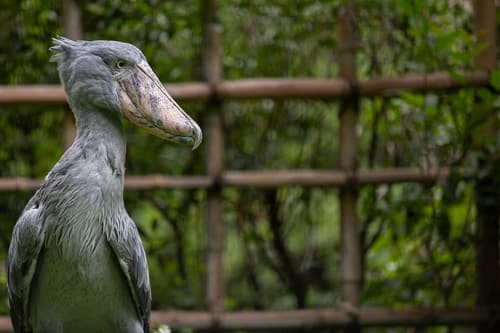
The easiest countries for tourists are Uganda, Zambia and Rwanda. South Sudan, home to the most shoebills, is a country that governments around the world advise against traveling to.
| Country | Place | How you see them |
|---|---|---|
| Uganda | Mabamba Bay Wetland | A boat paddled by a local guide |
| Uganda | Murchison Falls National Park | A boat trip down the Nile |
| Zambia | Bangweulu Wetlands | Boat or dugout canoe |
| Rwanda | Akagera National Park | Hidden deep in the wetlands. A sighting is not guaranteed |
| South Sudan | Sudd wetland | Not recommended as a tourist destination |
Rough access and seasons are in Where to see wild shoebills in Africa.
Where can you see shoebills in Europe?
In Europe, you can see them at 5 facilities in 5 countries. According to Prague Zoo (March 2025), Europe outside Russia keeps 8 shoebills.
Prague Zoo's 2 pairs are both wild-born and arrived in 2004. At Pairi Daiza in Belgium, a chick hatched in captivity for the first time in the world in 2008. Abou at Exmoor Zoo in the UK has parents living at Pairi Daiza.
At Pairi Daiza, you can see shoebills only from mid-May to September. Moscow Zoo's exhibit has summer and winter sections, and infrared heaters.
KouFrom here on, this is Kou's guess. The shoebill's homeland is the wetlands near the equator, from South Sudan to Zambia. European facilities limit the season when visitors can see them, or use heaters. Preparing for the cold of winter may be the key point when keeping shoebills in cold countries.
For details, see Zoos where you can see shoebills in Europe.
Where can you see shoebills in Asia?
They are at 8 facilities in Japan, Bird Paradise in Singapore and Sacheon Aramaru Aquarium in South Korea (as of October 2026). None were found in mainland China, Taiwan or Hong Kong.
In Japan, 15 birds live at 8 facilities. They include Ueno Zoo (恩賜上野動物園) in Tokyo, Kobe Animal Kingdom (神戸どうぶつ王国) in Hyogo Prefecture and Kakegawa Kachoen (掛川花鳥園) in Shizuoka Prefecture.
Bird Paradise in Singapore is a bird park that opened in 2023. The shoebills live in the "Heart of Africa" area, which brings together birds from Africa. This area is the park's largest aviary, covering 1.55 ha.
Zane, born in 2006, is described in the official popularity vote as so still that visitors mistake him for a statue. In South Korea, only one bird lives there: a male named Bill.
For details, see Where to see shoebills in Asia and Can you see shoebills in China?.
Where can you see shoebills in the Americas and Oceania?
In the Americas, you can see them only at 2 facilities in the USA. None were found in Oceania.
The two are ZooTampa in Tampa, Florida, and the Dallas World Aquarium in Dallas, Texas. In October 2026, both had the shoebill listed in the animal pages of their official websites.
In Canada, Mexico, South America, Australia and New Zealand, we found no facility that keeps shoebills. For details, see Zoos in the USA where you can see shoebills.
What is the history of shoebills in zoos around the world?
These are events whose years we could confirm in official materials or news reports, listed from oldest to newest.
| Year | Event |
|---|---|
| 1971 | Bill arrives at Izu Shaboten Zoo (伊豆シャボテン動物公園) in Shizuoka Prefecture. Bill lived there until 2020 |
| 1980s | Keeping begins at a facility in San Diego, USA |
| 1995 | First exhibit at Jurong Bird Park in Singapore |
| 2004 | Two wild-born pairs arrive at Prague Zoo |
| 2006 | Four birds arrive at ZooTampa from Tanzania |
| 2008 | The first hatching in captivity in the world, at Pairi Daiza in Belgium |
| 2009 | The first chick in North America, at ZooTampa. The second in the world |
| 2016 | First exhibit in South Korea, at the Dinosaur Expo in Goseong |
| 2018 | A pair arrives in Singapore from Qatar |
| 2024 | Moscow Zoo opens Russia's first shoebill exhibit |
| 2025 | A young pair arrives at Kobe Animal Kingdom (神戸どうぶつ王国) from the Democratic Republic of the Congo |
| 2026 | The first egg at the facility, at UWEC in Uganda |
Bill of Izu Shaboten Zoo died at an estimated age of 50 or more. Only after Bill died was it found that Bill was a female.
How many chicks have hatched in zoos worldwide?
In the range we searched, 2. They are Pairi Daiza in Belgium in 2008 (2 chicks) and ZooTampa in the USA in 2009 (1 chick).
While raising its chick, ZooTampa stayed in touch with Pairi Daiza. It also received advice from a facility in San Diego, which has kept shoebills longer than any other in North America.
There are developments in Africa too. At the Bangweulu Wetlands in Zambia, a facility for raising eggs and chicks was built in 2022, and 3 chicks have hatched there. At UWEC in Uganda, the first egg at the facility was being incubated in March 2026. We did not find whether it hatched.
In Japan, Ueno Zoo, Chiba Zoological Park (千葉市動物公園) and Kobe Animal Kingdom (神戸どうぶつ王国) are working toward breeding (as of October 2026).
KouFrom here on, this is Kou's guess. ZooTampa raised its chick while staying in touch with the Belgian facility that was the first to succeed. Because successful cases are so few, sharing experience across borders may become a big help for the next breeding.
For details, see Shoebill breeding.
Why are there so few places to see shoebills?
Wild numbers are small, and moving birds between countries requires permits. Chicks born in zoos are still only a handful.
- Shoebills have been in Appendix II of CITES (the convention that governs international trade in wild animals and plants) since October 1987. Export requires a permit from the exporting country
- Wild adults number 3,300 to 5,300. On the IUCN (International Union for Conservation of Nature) Red List, the shoebill is Vulnerable (VU)
- In the wild, each bird lives alone in its own territory (as explained by Ueno Zoo)
- Chicks hatched in captivity: 2 cases in the range we searched
Birds sometimes move between facilities for breeding. Milly (ミリー) and Hatuwe (ハトゥーウェ) of Ueno Zoo are scheduled to move to an off-exhibit facility for breeding. The move was planned for October 26, but on October 23 a postponement was announced, and no new date is set (as of October 23, 2026).

Why is the shoebill called "the world's most motionless bird"?
Because it stands still for a long time while waiting for prey. However, we found no record that compares how long different birds stay still.
According to the Dallas World Aquarium's description, the shoebill waits for a long time without moving. Then it lunges at its prey in less than a second.
Zane in Singapore is also described as so still that visitors mistake him for a statue. The reasons are explained in Why don't shoebills move?.
What should you check before going to see shoebills?
The facility's official information, and the travel advice published by your own government. The number of birds and the exhibits change from time to time.
- Exhibit periods: Pairi Daiza shows shoebills from mid-May to September. Chiba Zoological Park (千葉市動物公園) has paused its exhibit until around spring 2028
- At facilities where the birds move between indoor and outdoor areas, there are days when you cannot see them
- If you go to see wild birds, check not only Japan's Ministry of Foreign Affairs but also the travel advice of your own government (for example, the UK government advises against all travel to South Sudan)
- Check prices and opening hours on each facility's official website
Sources
- BirdLife International: Shoebill species factsheet (2018 assessment; estimated numbers and the share in South Sudan)
- IUCN Red List: Balaeniceps rex
- Prague Zoo: Shoebill (March 2025; 8 birds in Europe and the 2004 arrival; in Czech)
- Radio Prague: Prague Zoo opens its "Bird Wetlands" (2010; about 40 shoebills kept worldwide)
- Pairi Daiza: Shoebill (the world's first hatching in 2008; viewing period)
- Exmoor Zoo: Shoebill
- Weltvogelpark Walsrode: Shoebill (in German)
- Moscow 24: Moscow Zoo opens its exhibit (June 2024; in Russian)
- ZooTampa: Animal list
- Killmar (2010): The first hatching in North America at Tampa's Lowry Park Zoo (AFA Watchbird magazine)
- FOX13: ZooTampa's shoebills back on public display (March 2021)
- Dallas World Aquarium: Shoebill stork
- Bird Paradise: Shoebill
- Mandai: Zane in the 25 Stars of Mandai
- Mandai: The opening of Bird Paradise (2023; size of Heart of Africa)
- Mandai: The pair's arrival in 2018 and the first exhibit in 1995
- Sacheon Aramaru Aquarium: Introducing the shoebill (in Korean)
- Gyeongnam Domin Ilbo: The only shoebill in Korea (September 30, 2026; in Korean)
- Seoul Shinmun: Korea's first shoebill exhibit (2016; in Korean)
- Izu Shaboten Zoo: About Bill the shoebill (PDF; in Japanese)
- Kobe Animal Kingdom: New shoebills have arrived (June 2025; in Japanese)
- Uganda Wildlife Authority: The shoebill egg at UWEC (March 2026)
- African Parks: Incubating a Future in Bangweulu (the hatching of 3 chicks)
- Ueno Zoological Gardens: Moving the shoebills to an off-exhibit facility (postponement announced on October 23, 2026; in Japanese)
- Chiba Zoological Park: Pause of the shoebill exhibit (2026; in Japanese)
- Species+ (CITES listing record): Balaeniceps rex
- UK government (FCDO): Travel advice for South Sudan
 Read next