What is a shoebill? What family is it, and what kind of bird? Size, home and food

The shoebill is a bird of the swamps of east-central Africa, with a huge bill shaped like a shoe. It is loved around the world for the way it stands perfectly still while it waits for prey.
At a glance
This article walks through 12 topics, in this order.
- What is a shoebill, and what kind of bird is it?
- What family does the shoebill belong to?
- What does the shoebill's name mean?
- How big is a shoebill compared with other birds?
- What are the shoebill's main features?
- Where do shoebills live?
…and 6 more in the contents below.

Contents
- What is a shoebill, and what kind of bird is it?
- What family does the shoebill belong to?
- What does the shoebill's name mean?
- How big is a shoebill compared with other birds?
- What are the shoebill's main features?
- Where do shoebills live?
- How does the shoebill live?
- How do shoebills raise their young, and how long do they live?
- Is the shoebill endangered?
- Where can you see a shoebill?
- Where should I start reading about shoebills?
- Sources
What is a shoebill, and what kind of bird is it?
The shoebill is a large bird that lives only in the swamps of east-central Africa. It is known for its huge, shoe-shaped bill and for hunting by standing absolutely still.
As a rule, birds have long been named and grouped by how they look. The shoebill was once placed with the storks because it looks like one. That view has since changed.
First, here are the basic numbers for the shoebill in one table.
| Item | Shoebill |
|---|---|
| Scientific name | Balaeniceps rex (Latin for "king with the head of a whale") |
| Classification | Order Pelecaniformes, family Balaenicipitidae, genus Balaeniceps |
| Standing height | 110 to 140 cm (up to 152 cm) |
| Wingspan | 230 to 260 cm |
| Weight | 4 to 7 kg (on average about 5.6 kg for males and 4.9 kg for females) |
| Bill length | 18.8 to 24 cm |
| Home | Swamps of east-central Africa |
| Favorite food | Lungfish |
| Lifespan | Longest record in captivity: 35.7 years |
| Adult population | 3,300 to 5,300 birds in the world (estimate) |
| Conservation status | Vulnerable (VU) |
What family does the shoebill belong to?
The shoebill belongs to the order Pelecaniformes and the family Balaenicipitidae. The shoebill is the only species in its family.
The family has only one genus, and the genus has only one species. There are no subspecies either (a subspecies is a regional variety within one species). A bird like this is called "one family, one genus, one species".
Its Japanese name, Hashibirokō (ハシビロコウ), ends in "kō", which means stork, but the shoebill is not a stork. DNA studies show that it is a close relative of pelicans and the hamerkop. Which of the three is closest to which is still debated among researchers.
The way reference books describe it has also changed over time. Older encyclopedias place it in the order Ciconiiformes (storks), while newer field guides place it in Pelecaniformes. You can read more in What is the shoebill related to? and Is a shoebill a stork?.
Fossils of the shoebill family have also been found. A bird called Goliathia comes from rocks in Egypt that are 34 to 28 million years old. For the "it looks like a dinosaur" idea, see Are shoebills living dinosaurs?.
What does the shoebill's name mean?
The Japanese name means "stork with a wide bill". The scientific name means "king with the head of a whale", and the English name means "shoe bill".
Different languages compare the same bird to different things. The name stories are split into separate articles by topic.
- The meaning of the Japanese name 嘴広鸛: What does the shoebill's Japanese name mean?
- The meaning of the scientific name Balaeniceps rex: Shoebill scientific name
- The meaning of the English name Shoebill: Why is it called a shoebill?
- Names in languages around the world: Shoebill names around the world
The scientific name was given in 1850 by the British ornithologist John Gould. For the history of how the bird became known in Europe, see When was the shoebill discovered?.
How big is a shoebill compared with other birds?
A shoebill stands 110 to 140 cm tall. That is about the same as, or a little taller than, the stork found in Japan, and with its wings spread it measures roughly 2.5 m across.
Here are the numbers next to other large birds of the wetlands.
| Bird | Height or length | Wingspan |
|---|---|---|
| Shoebill | Height 110 to 140 cm | 230 to 260 cm |
| Stork (Japan's kōnotori) | Length 112 cm | 200 cm |
| Grey heron | Length 84 to 102 cm | 155 to 175 cm |
| Great white pelican | Length 137 to 168 cm | 274 to 335 cm |
Height is how tall the bird is when standing. Length is measured from the tip of the bill to the tip of the tail. The two are measured differently, so treat the table as a rough guide.
The shoebill weighs 4 to 7 kg. The great white pelican weighs about 9 to 12 kg, so it is the heavier bird.
Next to a person, a shoebill stands about as high as an adult's chest to shoulder. For more detail on the numbers, see How big is a shoebill?, and for the bill, see Shoebill beak.
What are the shoebill's main features?
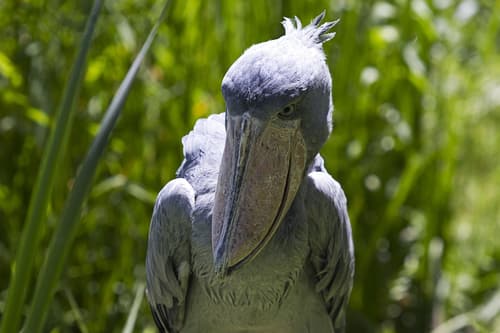
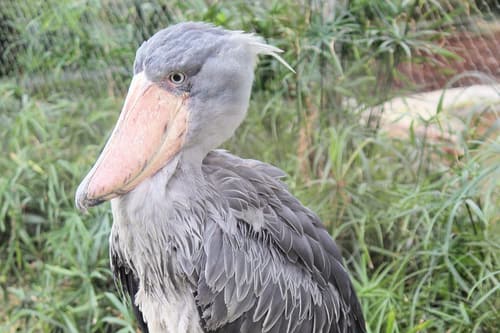
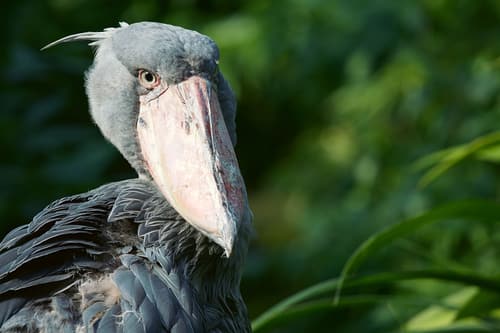
The most striking feature is its massive bill, as tall as it is wide. The tip curves into a hook, so it can hold slippery fish firmly.

The body is covered in bluish-grey feathers. There is a short crest (a tuft of decorative feathers) on the back of the head.
The eyes face toward the front of the face. That is why, when you meet one head-on, it seems to be glaring at you. For the eyes, see Shoebill eyes, and for the feathers, see Shoebill feathers.
Males tend to be bigger than females, with longer bills. Still, it is a hard bird to sex by looks alone. For how to tell them apart, see Shoebill male vs female, and for young birds, see Juvenile shoebill.
Where do shoebills live?
Shoebills live in the swamps of east-central Africa. Wild shoebills are found only in Africa.
According to the International Union for Conservation of Nature (IUCN), the countries where they live all year round are these eight.
- South Sudan and Sudan
- Uganda and Tanzania
- Zambia and the Democratic Republic of the Congo
- Rwanda and the Central African Republic
South Sudan has the most. A survey in 2002 estimated about 5,000 birds in South Sudan alone. The vast Sudd wetland is their big home.
There are also places where travelers can go to see wild birds. Mabamba Swamp and Murchison Falls in Uganda and the Bangweulu Wetlands in Zambia are well known. For their home, see Shoebill habitat and What is a papyrus swamp like?.
How does the shoebill live?
The shoebill waits quietly in the swamp for prey and lives by catching fish. It usually spends its time alone and does not fly around much.
What do shoebills eat?
The shoebill's favorite food is a fish called the lungfish. It also eats catfish, tilapia, frogs, water snakes and more.
What it eats changes with the swamp it lives in. In a study in the Bangweulu Wetlands in Zambia, 71% of the prey caught was catfish.
It swallows the fish whole. For food in general, see What do shoebills eat?, for the favorite fish, see What is a lungfish?, and for the hunting method, see How a shoebill hunts.
Why do shoebills stand still?
Shoebills stand still so the fish they hunt do not notice them. Waiting without moving is itself the hunting method.
One study watched shoebills in a Zambian swamp for more than 170 hours. The birds spent 85% of their time standing still, preening and doing other things that use almost no energy. They caught prey about once every 8 hours on average.
 Kou
From here on, this is Kou's guess. We spend 85% of our time on things that use almost no energy. We only catch a fish about once every 8 hours. So maybe our bodies have become ones that use very little energy and get by on an occasional meal.
For more, see Why do shoebills stand still?. For how they sleep, see How do shoebills sleep?, and for how they cope with hot days, see How shoebills beat the heat.
Do shoebills make sounds? Do they fly?
Shoebills rarely call from the throat. Instead they make a rattling sound by snapping the bill, called "bill clattering".
Clattering is seen, for example, when greeting a mate. In zoos you may also see it together with the "bow", when the bird lowers its head. For sounds, see Shoebill sounds, and for bowing, see Shoebill bowing.
The shoebill can really fly. It is not a migratory bird, so it lives around the same swamp and flies only when it needs to. For flight, see Can shoebills fly?.
How do shoebills raise their young, and how long do they live?
A shoebill usually lays 2 eggs, but usually only one chick grows up. They live a long time, and there is a record of 35.7 years in captivity.
Here is how raising young goes.
- Number of eggs: 1 to 3 (usually 2)
- Incubation: about 30 to 35 days (the male and female take turns)
- Leaving the nest: about 95 to 105 days after hatching
- Independence: about 125 days after hatching
- Age at which they can breed: 3 to 4 years
On hot days, the parents carry water in their bills and pour it over the eggs or chicks to cool them. For chicks, see Baby shoebills, for eggs, see Shoebill eggs, and for nests, see Shoebill nests. Why only one chick grows up is explained in Shoebill siblings.
Japan has a long-lived record too. "Bill" (ビル) at Izu Shaboten Zoo (伊豆シャボテン動物公園) in Shizuoka Prefecture came to Japan in 1971 and died in 2020. Its estimated age was over 50. For more on lifespan, see Shoebill lifespan.
KouFrom here on, this is Kou's guess. In one nesting, we can usually raise only one chick. In exchange, we sometimes live past 30 years. Maybe by living long and raising young many times, we have kept our numbers up.
Is the shoebill endangered?
The shoebill is listed as Vulnerable (VU), a threatened category, on the IUCN Red List. Adults are estimated at 3,300 to 5,300 in the world, and the number keeps going down.
The main reasons for the decline are these.
- Swamps, their home, are turned into farmland and grazing land
- Chicks and eggs are taken from nests for trade
- Fires, and people going close to nests
The average age at which parents produce offspring (the generation length) is estimated at 12.2 years. Once the numbers fall, it takes a long time for this bird to recover. International trade is regulated under Appendix II of CITES (the Convention on International Trade in Endangered Species of Wild Fauna and Flora), which means trade needs a permit.
For more, see Is the shoebill endangered?. Protection work is in Shoebill conservation, and the taking of chicks is in Shoebill smuggling. For whether you can keep one as a pet, see Can you keep a shoebill as a pet?.
Where can you see a shoebill?
You can see wild shoebills only in Africa. Around the world, only about 20 zoos and parks have them.

The first chick ever hatched in captivity was in 2008 at Pairi Daiza in Belgium. For details, see Shoebills at Pairi Daiza. Places in Europe, the Americas and Asia are collected in Where to see shoebills around the world.
In Japan, as of October 2026, 8 facilities and 15 birds have shoebills.
- Ueno Zoo (恩賜上野動物園), Tokyo
- Nasu Animal Kingdom (那須どうぶつ王国), Tochigi
- Chiba Zoological Park (千葉市動物公園), Chiba (off display until around spring 2028)
- Kakegawa Kachoen (掛川花鳥園), Shizuoka
- Kobe Animal Kingdom (神戸どうぶつ王国), Hyogo
- Matsue Vogel Park (松江フォーゲルパーク), Shimane
- Kochi Prefectural Noichi Zoological Park (高知県立のいち動物公園), Kochi
- Meccha Omoroi Zoo (めっちゃおもろい動物園), Koka City, Shiga
Exhibition plans can change. Please check each facility's official information before you go. For a guide to each place, see Where to see shoebills in Japan, and for the name of each bird, see Names of Japan's shoebills.
Where should I start reading about shoebills?
Start with whatever interests you most. Here are the articles on this site, grouped by topic.
| What you want to know | Articles |
|---|---|
| The body | Size, bill, eyes, feathers, legs and feet |
| Daily life | Why they stand still, hunting, food, sleep, predators |
| Raising young | Baby shoebills, eggs, nests, juveniles, captive breeding |
| Names and history | Japanese name, English name, scientific name, history of discovery |
| Protection | Endangered status, conservation, smuggling |
| Going to see one | Zoos in Japan, places around the world, wild birds in Africa |
| Just for fun | Why they are popular, photo tips, quiz, FAQ |
KouIf you are new here, start with "Why they stand still". It will change how much fun you have watching us at the zoo.
 Life & BodyWhy do shoebills stand still? Do they really not move for hours?Why do shoebills stand still? To wait for fish without being noticed. In the wild they spent 85% of their time standing, preening or sitting, and 14% walking.
 Life & BodyHow big is a shoebill? Height, wingspan and weight compared with people and other birdsShoebill size: 110 to 140 cm tall, a 230 to 260 cm wingspan and 4 to 7 kg. Compared with children, pelicans and herons, males vs. females, zoo records and chick growth.
 Japan’s Famous ShoebillsWhere can you see shoebills in Japan? All 8 zoos and bird parksWhere to see shoebills in Japan, by region: Kanto, Tokai, Kansai, Chugoku and Shikoku. Ueno Zoo, Nasu, Kakegawa, Kobe, Koka, Matsue, Noichi and more (Oct 2026).
Sources
- BirdLife International: Shoebill species factsheet
- IUCN Red List: Balaeniceps rex
- Animal Diversity Web (University of Michigan): Balaeniceps rex
- AnAge: Balaeniceps rex
- Mullers & Amar: study of foraging behaviour in the Bangweulu Wetlands, Zambia (Ostrich)
- Mullers & Amar (2015): study of parental nesting behavior and chick growth (Waterbirds)
- Smith & Ksepka (2015): study of Goliathia, a fossil of the shoebill family (Palaeontologia Electronica)
- Kotobank: Shoebill (World Encyclopedia, Encyclopedia Nipponica, Britannica Japan and others)
- Kyoto Prefecture Red Data Book 2015: Stork
- Animal Diversity Web: Grey heron (Ardea cinerea)
- Animal Diversity Web: Great white pelican (Pelecanus onocrotalus)
- Pairi Daiza: Shoebill
- Mirembe et al. (2018): Survival blueprint for the shoebill (EDGE of Existence)
- Izu Shaboten Zoo: materials on the shoebill "Bill" (PDF)
 Read next
Life & BodyHow big is a shoebill? Height, wingspan and weight compared with people and other birdsShoebill size: 110 to 140 cm tall, a 230 to 260 cm wingspan and 4 to 7 kg. Compared with children, pelicans and herons, males vs. females, zoo records and chick growth. Life & BodyHow long do shoebills live? Average, longest records and why they live longShoebill lifespan: a record of 35.7 years in captivity, and Japan's Bill lived to an estimated 50 or more. Why the average is unknown, and how it compares with herons.
 Life & BodyWhat do shoebills eat? Their favorite lungfish, how they eat and how muchWhat do shoebills eat? Mostly fish: lungfish above all, plus catfish. Differences by country, how often they catch prey, how they swallow it whole, and zoo diets.Life & BodyWhy do shoebills stand still? Do they really not move for hours?Why do shoebills stand still? To wait for fish without being noticed. In the wild they spent 85% of their time standing, preening or sitting, and 14% walking.
 Life & BodyWhat sound does a shoebill make? What bill clattering is and meansThe best-known shoebill sound is bill clattering, often compared to a machine gun. What makes the noise, what it means, the moo-like call, chick calls and storks.
 Life & BodyCan shoebills fly? How they fly, how far, and why they rarely doYes, shoebills fly. A 230 to 260 cm wingspan lets them even soar on rising warm air. Wingbeat rate, GPS flight distances, chicks' first flights, and how to see one fly.