How long do shoebills live? Average, longest records and why they live long

For a bird, the shoebill lives a long time. The longest firm record is 35.7 years, and one bird in Japan lived to an estimated 50 or more.
At a glance
This article walks through 11 topics, in this order.
- How long do shoebills live?
- Why is the shoebill's average lifespan unknown?
- What is the longest recorded shoebill lifespan?
- How does a shoebill's lifespan compare with other big birds?
- At what age does a shoebill become an adult?
- What threatens the lives of wild shoebills?
…and 5 more in the contents below.
Contents
- How long do shoebills live?
- Why is the shoebill's average lifespan unknown?
- What is the longest recorded shoebill lifespan?
- How does a shoebill's lifespan compare with other big birds?
- At what age does a shoebill become an adult?
- What threatens the lives of wild shoebills?
- Why do shoebills live so long?
- Can you tell a shoebill's age by its looks?
- Which shoebills have lived the longest in Japan and around the world?
- Do zoo shoebills live longer than wild ones?
- Sources
How long do shoebills live?
In captivity there are records of more than 35 years, and one bird lived to an estimated 50 or more. The average lifespan in the wild is still not clear.
The numbers differ quite a lot from source to source. Here is how the main sources put it.
| Source | How it describes shoebill lifespan |
|---|---|
| AnAge (a database of animal lifespans) | Longest in captivity 35.7 years (a single bird) |
| AEWA conservation plan (2013) | Several birds over 25 years in captivity, and one that lived at least 35 years. The wild average is unknown |
| Mandai Bird Paradise (Singapore) | An average of 30 years in the wild, up to 50 years in human care |
| ZooTampa (United States) | About 35 years |
| Izu Shaboten Zoo (伊豆シャボテン動物公園), Japan | "Bill" died at an estimated age of 50 or more (2020) |
AEWA is an international agreement to protect waterbirds of Africa and Eurasia. Here is the key point. The longest firmly recorded lifespan is 35.7 years, and with estimates included it is 50 or more. The number changes depending on which one you call the "longest".

Why is the shoebill's average lifespan unknown?
It is because there is no record of following a single wild bird for decades, from birth to death.
The lifespan of a wild bird is usually studied by putting a leg band (a numbered ring fitted to the leg) on it and seeing how many years later it is found. In the sources we checked, we could not find a record of a wild shoebill whose age was known from a leg band or the like.
One of the longer studies of shoebills is the GPS study in Zambia (Acácio et al., 2021). Even so, the tracking ran only from December 2011 to October 2018, about 7 years. Of the young birds that were tracked, 4 died or went missing before they became juveniles.
Shoebills are also hard to age by sight. According to an announcement from Izu Shaboten Zoo (伊豆シャボテン公園), apart from males being larger on average, there is no difference in looks between male and female.
The small number of wild birds, scattered across huge swamps, also makes surveys difficult. The adult population of the world is estimated at 3,300 to 5,300 birds (IUCN). In the Sudd wetland in South Sudan, there is an estimate of 0.05 birds per km² (AEWA). That works out to about 1 bird per 20 km².
What is the longest recorded shoebill lifespan?
The longest in the records is AnAge's 35.7 years. "Bill" in Japan lived to an estimated 50 or more.
AnAge's 35.7 years is a record based on a paper on animal lifespans published in 1938 (Flower). That means a record from nearly 90 years ago is still used as the longest.
According to announcements from Izu Shaboten Zoo (伊豆シャボテン動物公園) in Shizuoka Prefecture, Bill's life went as follows.
- 1971: Came to Japan from Khartoum Zoo in Sudan
- 1971 to 1981: Lived for 10 years at the Institute of Evolutionary Biology (進化生物学研究所)
- April 1981: Came to Izu Shaboten Zoo as the male half of a pair with a female named Shu (シュー)
- August 6, 2020: Died of old age, at an estimated 50 or more
- August 2020: A dissection showed that Bill was actually a female
- April 28, 2021: On the 40th anniversary of arriving at the zoo, put on display as a mounted specimen
Bill spent about 49 years in Japan. Since the age is an estimate, it is not included in AnAge's records. The "Bill" at an aquarium in South Korea is a different bird.
 Kou
From here on, this is Kou's guess. The Izu zoo reportedly did not catch the aging Bill for checkups, so as not to put a strain on the bird. Maybe a quiet life built on trust with people helped Bill live long, too.
How does a shoebill's lifespan compare with other big birds?
The shoebill's longest record is about the same as those of herons and storks. Large pelicans have records of more than 50 years.
Using the same AnAge database, here are the longest records for other large water birds.
| Bird | Longest record | Where the record was set |
|---|---|---|
| Shoebill | 35.7 years | In captivity |
| White stork (the stork of Europe) | 39 years | In the wild |
| Grey heron | 37.5 years | In the wild |
| Great white pelican | 51 years | In captivity |
Wild and captive records are mixed together, so they cannot be compared simply. AnAge rates the number of records for the white stork and grey heron as "medium" and for the shoebill as "small".
For a comparison with people, Izu Shaboten Zoo (伊豆シャボテン動物公園) described Bill, who passed 50, as "over 100 in human years".
At what age does a shoebill become an adult?
Shoebills become adults and can breed at around 3 to 4 years old.
In AnAge, the age at which a female becomes adult is given as 1,090 days (about 3 years). Uganda's conservation plan (2018) also gives 3 to 4 years, based on BirdLife International.
Here is a rough guide to a shoebill's life, from the numbers in the sources.
| Stage | Rough guide |
|---|---|
| Incubating the eggs | About 30 to 35 days |
| Leaving the nest | About 95 to 105 days after hatching |
| Becoming good fliers | About 105 to 112 days after hatching |
| Becoming independent | About 125 days after hatching |
| Becoming an adult | 3 to 4 years old |
| Generation length (the average age at which parents have their young) | 12.2 years |
| Longest recorded lifespan | 35.7 years (in captivity) |
One to three eggs are laid, but usually only one chick grows up. They raise young once a year, and at most one chick at a time. When numbers fall, it takes a long time for the population to recover. The early years are covered in Juvenile shoebill.
What threatens the lives of wild shoebills?
Adults have few natural enemies, but many birds die as eggs or chicks.
According to the Animal Diversity Web (University of Michigan), few animals attack adult shoebills. The targets are the eggs and chicks in the nest. In the Bangweulu Wetlands of Zambia, there are these records.
- 2011: Of 10 nests that were watched, about 20% fledged chicks. The main cause was people taking chicks away
- 2012 to 2013: At nests that were protected, 0.89 chicks fledged per nest
- 11 nests in another year: 9 nests fledged chicks. 1 nest was attacked by an animal thought to be a snake or a monitor lizard, and 1 was lost to a fire
The AEWA conservation plan lists wildfires, illegal trade, hunting and killing by fishers as causes that increase the number of birds dying. At the meeting that drew up the plan, wildfires and trade were judged to be the biggest threats in the long term.
Uganda faces the same problems. The Mabamba Swamp is a wetland registered under the Ramsar Convention (an international treaty to protect important wetlands). The registration document lists poaching of shoebills and the removal of young birds for sale as problems. Conservation efforts are covered in Is the shoebill endangered? and Shoebill predators.
KouFrom here on, this is Kou's guess. Adults have few natural enemies, and the danger is concentrated in the chick stage. So maybe once a bird grows up, it can live a long time in the wild, too.
Why do shoebills live so long?
In the sources we checked, we could not find a study that clearly explains why shoebills live long. But their way of life has a feature: it uses little energy.
In the observations in Zambia, shoebills spent 85% of their time on low-effort behavior such as standing still and preening. They caught prey about once every 8.3 hours on average.
They spent only about 1% of the observed time flying. The reason they stay still is covered in Why shoebills stand still.
Raising young is slow too. They raise young once a year, and usually only one chick survives. The generation length (the average age at which parents have their young) is 12.2 years. It is a bird that gives a lot of time to a small number of young. How they grow from the egg is summed up in Shoebill eggs.
KouFrom here on, this is Kou's guess. Spending 85% of the day standing still may mean they use up little energy. Maybe the unhurried way of life and the long lifespan are connected somehow.
Can you tell a shoebill's age by its looks?
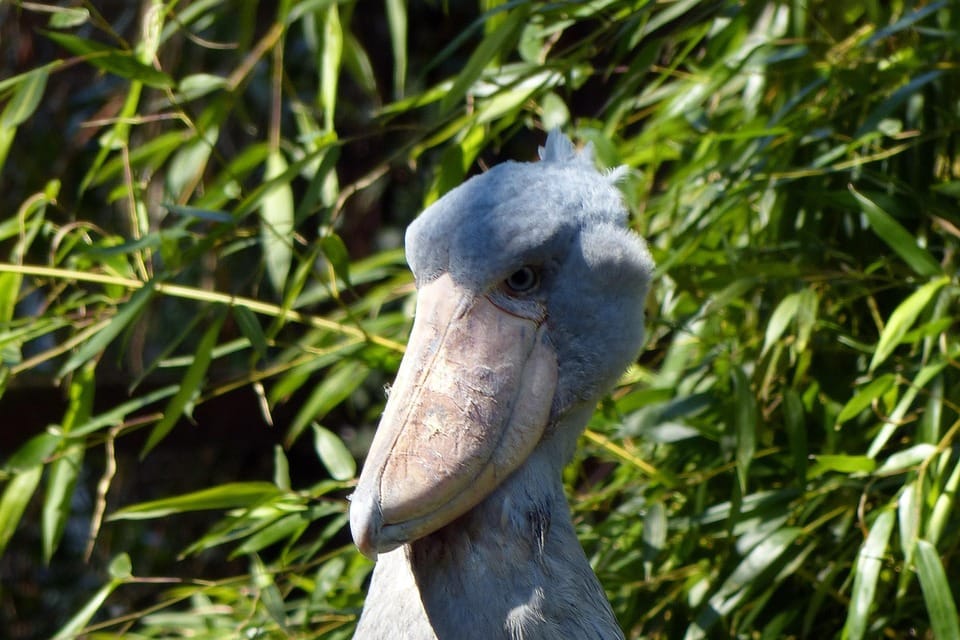
It is hard to know an exact age from looks alone. The clues are eye color and feather color.
According to Kobe Animal Kingdom (神戸どうぶつ王国), the area around a shoebill's pupil is yellow when it is young and changes to blue as it grows. The two birds that arrived in 2025 still had a yellow iris (the colored part around the pupil), so they were introduced as young birds.
According to the Animal Diversity Web, young birds that have left the nest are a slightly darker gray than adults. But no method is known for reading the age of a bird once it is an adult.
| Clue | When young | Adult |
|---|---|---|
| Color around the pupil | Yellow | Gradually changes to blue |
| Feather color | Slightly darker gray than adults | Bluish gray |
| Breeding | Does not breed | From about 3 to 4 years old |
Zoo descriptions also rarely give birth dates. Kochi Prefectural Noichi Zoological Park (高知県立のいち動物公園) lists the birth dates of Sasa and Kashishi as "unknown". The materials from Chiba Zoological Park and Kobe Animal Kingdom likewise give arrival dates but not birth dates. Eyes are covered in Shoebill eyes.
Which shoebills have lived the longest in Japan and around the world?
In Japan, Shizuka (しずか) of Chiba Zoological Park has lived there since 1989. Her age is not made public, but it has been 37 years since she arrived (as of 2026).
Here are the birds whose arrival year or birth year is known from official materials.
| Name | Facility | What official materials show |
|---|---|---|
| Shizuka (しずか), female | Chiba Zoological Park (千葉市動物公園), Chiba | Arrived October 19, 1989 |
| Jitto (じっと), male | Chiba Zoological Park (千葉市動物公園), Chiba | Arrived July 22, 2005 |
| Marimba (マリンバ), female | Kobe Animal Kingdom (神戸どうぶつ王国), Hyogo | Arrived November 25, 2015 |
| Futaba (ふたば), female | Kakegawa Kachoen (掛川花鳥園), Shizuoka | Arrived in 2016. 2026 is her 10th year |
| Zane (ゼイン) | Mandai Bird Paradise, Singapore | Born January 1, 2006 |
| Bill (ビル) (died in 2020) | Izu Shaboten Zoo (伊豆シャボテン動物公園), Shizuoka | Came to Japan in 1971. Estimated 50 or more |
The shoebills at Chiba Zoological Park are off display until around spring 2028. Exhibits can change, so check the official information before you go. The two birds in Chiba are covered in Shoebills in Chiba Zoological Park.
Jurong Bird Park in Singapore began exhibiting shoebills in 1995. It is the predecessor of today's Mandai Bird Paradise. The last bird there died in 2015, and a new pair arrived from Qatar in 2018. When they arrived, the male was 11 years old and the female was 17.
Not many shoebills live in the world's zoos. According to the AEWA conservation plan, at the end of 2012 there were 40 birds in 16 institutions that belong to the World Association of Zoos and Aquariums (WAZA).
Do zoo shoebills live longer than wild ones?
We cannot say for sure, because there are no wild records good enough to compare with. The zoo in Singapore describes an average of 30 years in the wild and up to 50 years in human care.
In zoos, food comes every day, and there is no worry about wildfires or illegal removal. On the other hand, only a few zoos in the world have succeeded in breeding shoebills in captivity. In Japan, as of October 2026, there has not been a single case yet.
All the shoebills in Japan today are birds that came from overseas. Keeping each bird healthy for a long time is an important job for the zoos. Breeding efforts are covered in Shoebill breeding in captivity, and the birds in Japan in Names of Japan's shoebills.
Sources
- AnAge: Balaeniceps rex
- AnAge: Ciconia ciconia (white stork)
- AnAge: Ardea cinerea (grey heron)
- AnAge: Pelecanus onocrotalus (great white pelican)
- Dodman (2013): International Single Species Action Plan for the Conservation of the Shoebill (AEWA Technical Series No.51)
- Mandai Bird Paradise (Singapore): Shoebill
- Mandai: Stars of Mandai, Zane
- ZooTampa: Shoebill Stork
- Izu Shaboten Zoo (伊豆シャボテン公園): Press release, "Bill" was a female (August 28, 2020, in Japanese)
- Izu Shaboten Zoo (伊豆シャボテン公園): Press release, 40th anniversary of "Bill" at the zoo (April 26, 2021, in Japanese)
- Acácio et al. (2021): Changes in surface water drive the movements of Shoebills (Scientific Reports)
- Mullers & Amar (2015): Parental nesting behavior and chick growth (Waterbirds)
- Mullers & Reid (2014): Ornithological Observations 5
- Ramsar Convention: Registration document for Mabamba Bay Wetland (NatureUganda, 2005)
- Mullers & Amar: Foraging behaviour in the Bangweulu Wetlands, Zambia (Ostrich)
- Mirembe et al. (2018): Conservation plan for the shoebill in Uganda (EDGE of Existence)
- Animal Diversity Web (University of Michigan): Balaeniceps rex
- IUCN Red List: Balaeniceps rex
- Chiba Zoological Park (千葉市動物公園): On the suspension of the shoebill exhibit (press release, 2026, in Japanese)
- Kobe Animal Kingdom (神戸どうぶつ王国): Introducing the new shoebills (in Japanese)
- Kochi Prefectural Noichi Zoological Park (高知県立のいち動物公園): Shoebill (in Japanese)
- Mandai: Shoebill returns to Jurong Bird Park (July 2018)
- BirdLife International: Shoebill species factsheet
 Read next
 Life & BodyWhat is a shoebill? What family is it, and what kind of bird? Size, home and foodWhat is a shoebill? A large bird of African swamps and the only member of its family. Size next to herons and pelicans, home, food, lifespan, and where to see one.
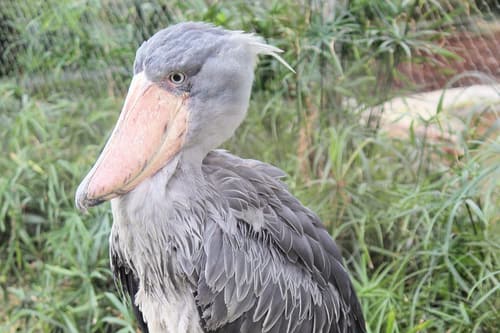 Life & BodyHow big is a shoebill? Height, wingspan and weight compared with people and other birdsShoebill size: 110 to 140 cm tall, a 230 to 260 cm wingspan and 4 to 7 kg. Compared with children, pelicans and herons, males vs. females, zoo records and chick growth.
 Life & BodyWhat do shoebills eat? Their favorite lungfish, how they eat and how muchWhat do shoebills eat? Mostly fish: lungfish above all, plus catfish. Differences by country, how often they catch prey, how they swallow it whole, and zoo diets.
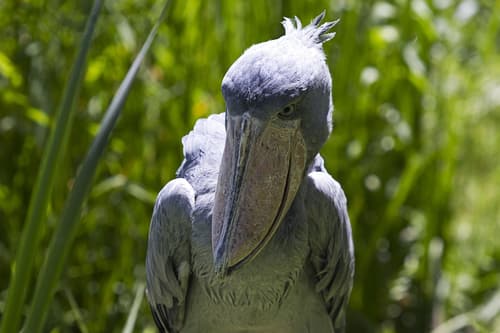 Life & BodyWhy do shoebills stand still? Do they really not move for hours?Why do shoebills stand still? To wait for fish without being noticed. In the wild they spent 85% of their time standing, preening or sitting, and 14% walking.
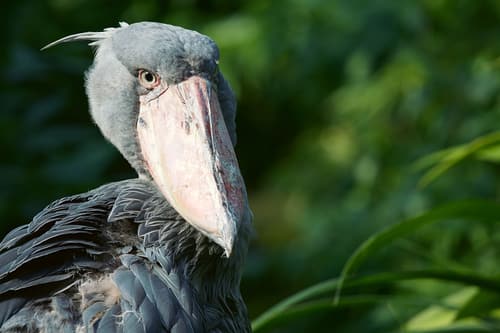 Life & BodyWhat sound does a shoebill make? What bill clattering is and meansThe best-known shoebill sound is bill clattering, often compared to a machine gun. What makes the noise, what it means, the moo-like call, chick calls and storks.
 Life & BodyCan shoebills fly? How they fly, how far, and why they rarely doYes, shoebills fly. A 230 to 260 cm wingspan lets them even soar on rising warm air. Wingbeat rate, GPS flight distances, chicks' first flights, and how to see one fly.